
I almost didn’t make it into 2026 and I have the battle scars to prove it. Surviving a serious life threatening illness puts everything else into perspective forever. So visiting Raglan this long weekend – with my wife Renea Mackie – has been an amazing tonic for us both after a very challenging 12 months.
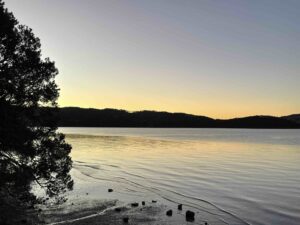
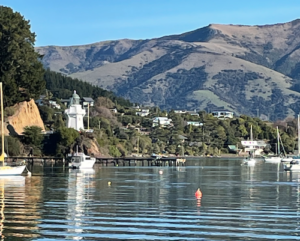
Raglan Harbour Sunset
Restful location with rejuvenating sea air, amazing views and some overdue quiet time for writing and reflection about what’s up next. Did I mention the cute laneways, lovely cafes, fresh fish & chips and friendly, creative locals? Nestled among the misty hills of coastal Waikato, this busy little town somehow balances the needs of alternative lifestylers, eager tourists and local Tainui people. At least superficially, it is a microcosm of our nation.
But in the midst of these simple pleasures, I’m also mindful that wider New Zealand is doing it tough right now in economic terms. The future quality of the healthcare system (that saved my life) and that of our once respected education and welfare institutions now looks at risk. Successive governments have failed to make smart decisions about moving our country up the value chain. We have not planned adequately for energy and climate security. Infrastructure capacity is still years behind population growth and land developments. On top of all this, environmental protections are being wound back.
I’ve been around long enough to witness the ebb and flow of numerous economic cycles. But this time it’s different. Society has never been so polarised politically. Young people and knowledgeable elders with clever ideas are not being heard or are giving up hope and leaving. In the meantime, as social equity erodes, we cling to incredibly outdated, divisive and binary 19th Century thinking around politics, race and economics.
It seems overdue that we review whether or not our political system and constitutional arrangements remain fit for purpose. At the very least we finally need to find a unifying sense of direction as a nation that for once does not entirely revolve around sport. We are so very fortunate to live in such a peaceful and beautiful place. But the worry is that the sun is setting and the rest of the world is rapidly leaving us behind.
Paul Spence is a commentator, researcher and a part-time university assistant lecturer in commerce and management. A previous co-founder of a successful New Zealand based global technology venture, co-founder and director of Creative Forest, principal at GeniusNet Research & GeniusReFi and a startup advisor. You can follow Paul on BlueSky @GeniusReFi or Twitter/X @GeniusNet

 During our travels over the last few weeks I have been assiduously avoiding all New Zealand media and political commentary. We are such a binary thinking and inwards looking nation, it is nice to have a break from it. But I couldn’t avoid seeing the recent remarks from Mayor Brown and Peter Gluckman both alluding to Auckland’s greatness as a “centre for innovation” whilst lobbying (of course) for government support.
 New Zealand faces a polycrisis due to decades of under-investment in public infrastructure. Indicative of this malaise are multiple
 The state government of Victoria has announced the first investments from a $2 billion fund for the commercialisation of research, science and technology. Breakthrough Victoria will focus on life sciences, agri-food, cleantech and digital technologies in a push to reboot the state’s post-Covid economy. The package includes $100 million for co-funding
  This week I conducted a small experiment. I really want to play my part to reduce emissions, so I’m in the market for a plug-in hybrid electric vehicle (PHEV). I’ve also been doing a couple of papers at our local university for interest recently and have just completed a marketing course at Masters level. So I’m up to speed with marketing tactics and sneaky selling strategies. This is where the fun begins.
 They called it the slap that reverberated around the world. A wealthy and privileged, angry man arrogantly displaying his lack of respect for a long established institution and the faithful community that had blindly supported him. No, I’m not referring to the infamous Oscars night incident, I’m talking about Grant Dalton’s acceptance of an offer from the city of Barcelona to host and fund the 2024 Americas Cup yacht race.
 This year has been remarkable if for no other reason than the pandemic has resurfaced some ugly divisions that continue to bubble away behind the easy-going facade of New Zealand society. We are doubtless challenged now more than ever on numerous complex topics, including environment, poverty, crime, health, immigration and race. So the need for change is absolutely genuine. But the manner in which change is now being enacted is both contemptuous and potentially self-defeating.